Watch out proficient gamers: machines may before long be desiring your occupations.
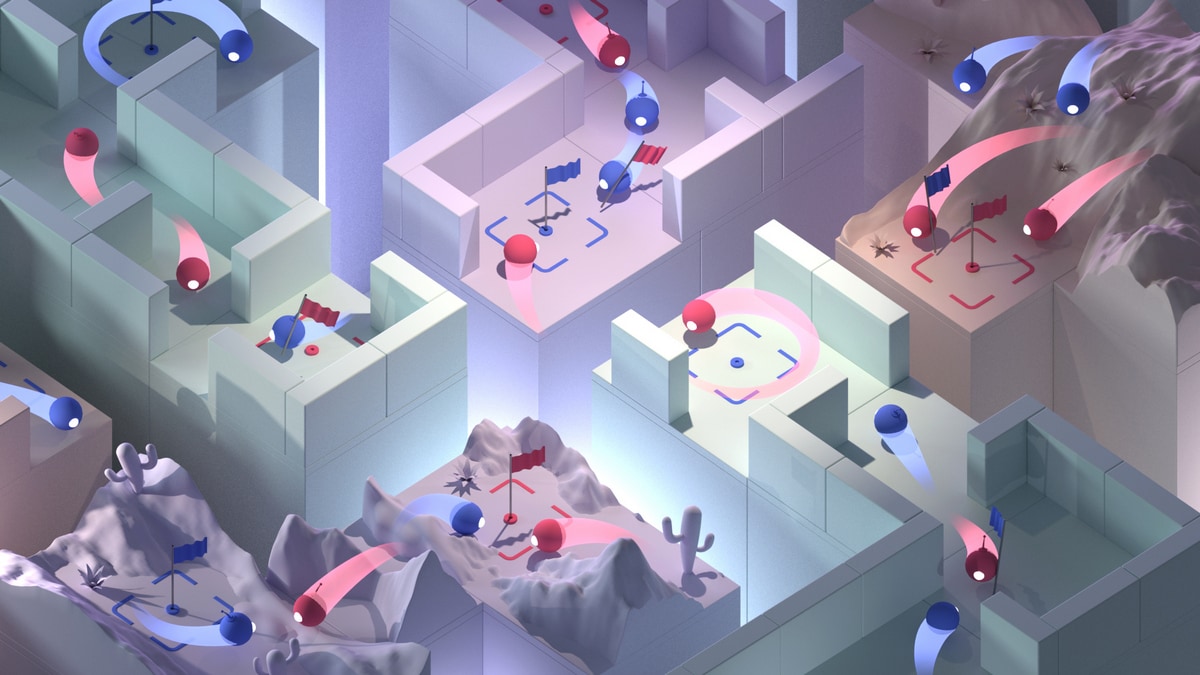
A group of software engineers at an English computerized reasoning organization has planned mechanized "specialists" that showed themselves how to play a focused first-individual multiplayer computer game shooter, and turned out to be so great they reliably beat people.
Crafted by the specialists from DeepMind, which is claimed by Google's parent organization Letters in order, was portrayed in a paper distributed in Science on Thursday and imprints the first run through the accomplishment has ever been cultivated.
Undoubtedly, PCs have been flexing their strength over people in one-on-one turn-based diversions, for example, chess as far back as IBM's Dark Blue beat Gary Kasparov in 1997. All the more as of late, a GoogleAI operator beat the world's main Go player in 2017.
In any case, the capacity to play multiplayer recreations including cooperation and collaboration in complex conditions had remained an unfavorable assignment.
For the investigation, the group driven by Max Jaderberg chipped away at a changed variant of Shudder III Field, an original shooter that was first discharged in 1999 yet keeps on flourishing in the eSports world.
The game mode they picked was "Catch the Banner," which includes working with partners to get the adversary group's banner while defending your own, constraining players to devise complex techniques blending animosity and guard.
After the operators had been offered time to prepare themselves up, their ability was coordinated facing proficient diversions analyzers.
"Indeed, even following 12 hours of training, the human game analyzers were just ready to win 25% of amusements against the specialist group," the group composed, while the operators' exhibition stayed unrivaled notwithstanding when their response times were falsely backed off to human dimensions.
New strides for computer based intelligence
The software engineers depended on purported "Support Learning" (RL) to instill the specialists with their smarts.
"At first, they don't knew anything about the world and rather were doing totally irregular stuff and ricocheting about the spot," Jaderberg told AFP.
The specialists were educated to compensate themselves for catching the banner, yet the group additionally conceived a progression of new and inventive strategies to drive the limits of what is conceivable with RL.
"One of the commitments of the paper is every specialist learns its own interior reward signal," said Jaderbeg, implying that the computer based intelligence players gave themselves a gesture of congratulations of differing extent for achieving undertakings, for example, getting the banner or effectively shooting a rival.
Next, they found that preparation a populace of operators together, as opposed to each one in turn, caused the populace all in all to adapt a lot quicker.
They additionally formulated another design of alleged "two timescale" realizing, which Jaderberg compared to the postulation of the book "Thinking Quick and Moderate."
"You have one piece of the operator which kicks in all respects rapidly, it refreshes its very own convictions all around rapidly, and you have another piece of the specialist, which refreshed conviction at a slower rate, and these two convictions impact one another and help shape the manner in which the operator finds out about the world," he said.
At long last, randomizing the guide for each new match was critical. "That implied the arrangements that the operators observe must be general - they can't simply remember a grouping of activities," said co-creator Wojciech Czarnecki.
Morals questions
The group did not remark, be that as it may, on the artificial intelligence's potential for later use in military settings.
DeepMind has openly expressed in the past that it is focused on never dealing with any military or reconnaissance ventures, and "shoot" does not seem even once in the paper (the procedure is depicted rather as labeling adversaries by pointing a laser contraption at them).
Pushing ahead, Jaderberg said his group might want to investigate having the operators play in the full form of Tremor III Field and discover ways his man-made intelligence could take a shot at issues outside of amusements.
"We use amusements, similar to Catch the Banner, as moving situations to investigate general ideas, for example, arranging, technique and memory, which we accept are fundamental to the improvement of calculations that can be utilized to help take care of certifiable issues."


0 Reviews:
Post Your Review